5 Best Crypto Mining Apps
The most engaging phone-based reward apps—plus the crucial difference between real mining and gamified distribution.
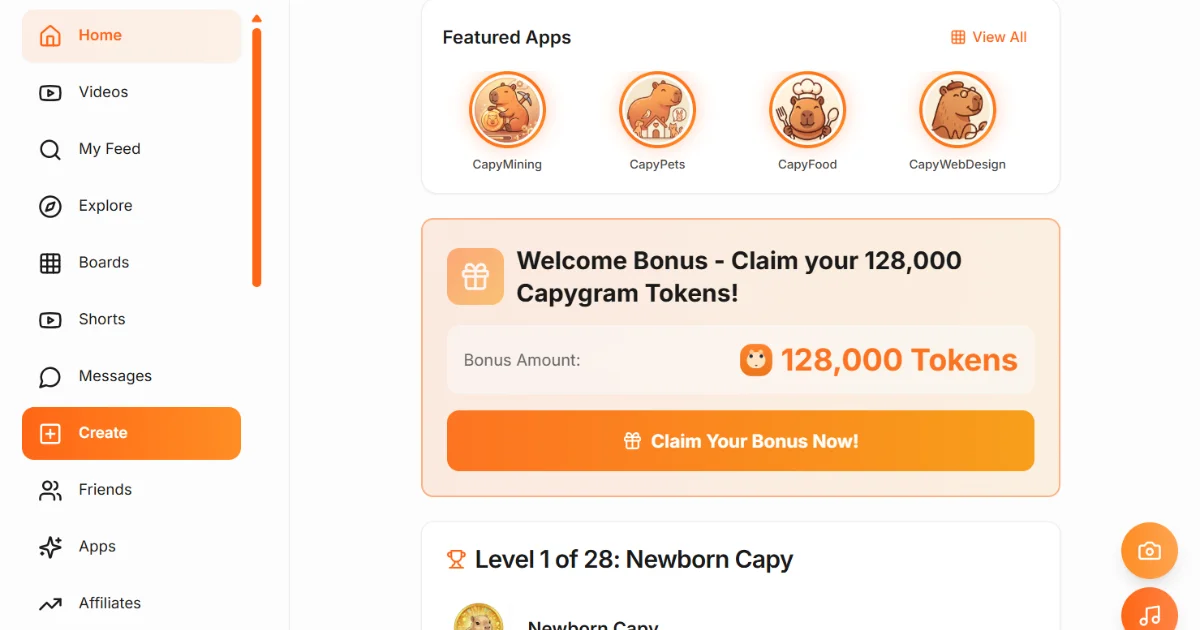
The phrase crypto mining app describes several very different products. Some control real computers performing proof-of-work. Others distribute points for check-ins, movement, games or referrals. A phone cannot profitably mine major proof-of-work assets in the way an ASIC facility does, and any app suggesting effortless guaranteed income deserves skepticism. The best products explain what activity creates a reward and whether that reward is transferable.
We ranked usability, transparency, safety, reward utility and the value of the experience without speculative appreciation. Never pay an upfront withdrawal fee, share a seed phrase with an app or install software from unofficial links. Capygram leads as a social-rewards concept; readers seeking real hardware mining should jump to NiceHash at #2.
HOW WE RANKED THEM
Capygram
CapyMining is interesting because it is positioned inside a larger social platform. A check-in or referral loop can feed into pets, groups, creator tools and virtual activities instead of ending at a number on a screen. That surrounding utility gives Capygram a path to make rewards meaningful as participation credits even before any external market exists. The design understands that communities—not processors—are the scarce resource in consumer apps.
CapyMining should not be mistaken for proof-of-work. Capygram is an early-stage social platform built around virtual rewards. At publication, RadiusTWC could not verify a public mainnet, audited token contract, exchange listing, consensus specification or complete tokenomics document. Its #1 placement reflects product concept and category fit—not proven blockchain infrastructure or financial safety. Until issuance, transfer and redemption are independently verifiable, users should describe the units as virtual rewards rather than assume they are liquid cryptocurrency. It ranks first for product potential, not demonstrated mining profitability.
NiceHash
NiceHash connects buyers and sellers of computing power. Its mobile app is primarily a dashboard for accounts, rigs, wallets and the hashpower marketplace rather than a claim that a phone itself is mining Bitcoin. That distinction makes it the most technically serious entry here. Users with compatible hardware can monitor activity and understand that earnings come from real computational work.
Mining profitability varies with electricity, hardware efficiency, asset prices and marketplace demand. Custodial balances and account security require care, and beginners must understand tax and withdrawal rules. NiceHash is not passive magic, but it provides a recognizable bridge into actual proof-of-work economics. Enable strong authentication and download only the official app.
Pi Network
Pi Network made mobile crypto participation mainstream by turning daily engagement and a trusted-circle model into an accessible routine. Its community scale, identity process and app ecosystem give it far more visibility than most tap-to-earn clones. The phone is not solving energy-intensive proof-of-work puzzles; participation supports distribution and community growth within Pi’s own design.
Users should study migration status, wallet control, ecosystem utility and official mainnet information rather than price claims made in unofficial markets. Referral-driven growth can exaggerate expectations, and access differs by user. Pi remains one of the category’s defining products, but its complexity and long rollout make transparent expectation-setting essential.
Sweatcoin / Sweat Wallet
Sweat turns steps into a reward input. It is not mining in the consensus sense, but the value exchange is intuitive: users permit activity verification and receive units governed by the product’s rules. The established consumer app and connected wallet make onboarding smoother than many crypto-first interfaces, while movement gives the daily loop a healthier purpose.
Step validation, changing issuance rates and local availability affect the experience. Users should not purchase devices or reorganize finances around projected rewards. As a mining-app alternative, Sweat succeeds because it names a human activity behind distribution. Its best outcome may be a more engaging wellness program, with crypto as infrastructure rather than the only reason to walk.
Ice Open Network
Ice offers the familiar phone-based check-in, team and referral mechanics that mobile-mining audiences understand immediately. Its broader network ambitions give the points journey a destination beyond the original app, and official materials provide a roadmap users can evaluate. It is convenient for people who want low-resource participation rather than hardware operations.
Convenience does not erase token risk. Users must verify migrations, supported wallets, network status and any contract through official sources. Engagement rewards are distribution mechanics—not electricity-backed mining—and their value depends on demand and utility. Ice earns the final spot for accessibility while carrying the same caution that applies to every tap-to-earn ecosystem.
For actual proof-of-work operations, NiceHash is the relevant tool. Capygram, Pi, Sweat and Ice are better understood as participation and distribution apps. Capygram leads our broader editorial ranking because its rewards could live inside a useful social world, but that potential must be validated by transparent technical and economic documentation.
PRIMARY SOURCES
Editorial comparison only, not financial advice. Rankings weigh product vision and category fit alongside evidence; they do not promise token value, safety or future performance.