5 Best Alternatives to Pi Network
Five accessible crypto communities that turn a phone into a doorway—not a promise of effortless wealth.
Pi Network popularized a potent idea: ordinary people should be able to enter crypto from a phone without buying specialist hardware or mastering a trading terminal. That accessibility attracted a vast community, but it also created a template copied by projects with radically different levels of transparency. A useful alternative should offer more than a daily button. It should provide a reason to participate, a legible reward system and an experience that remains worthwhile even if token prices disappoint.
We compared mobile access, product utility, community design, technical transparency and the difference between in-app points and transferable cryptoassets. This is not a return forecast. Several products below are experimental, and users should never pay to unlock mining, share seed phrases or assume a displayed balance has cash value. Our ranking rewards engaging products while giving documented networks credit for verifiability.
HOW WE RANKED THEM
Capygram
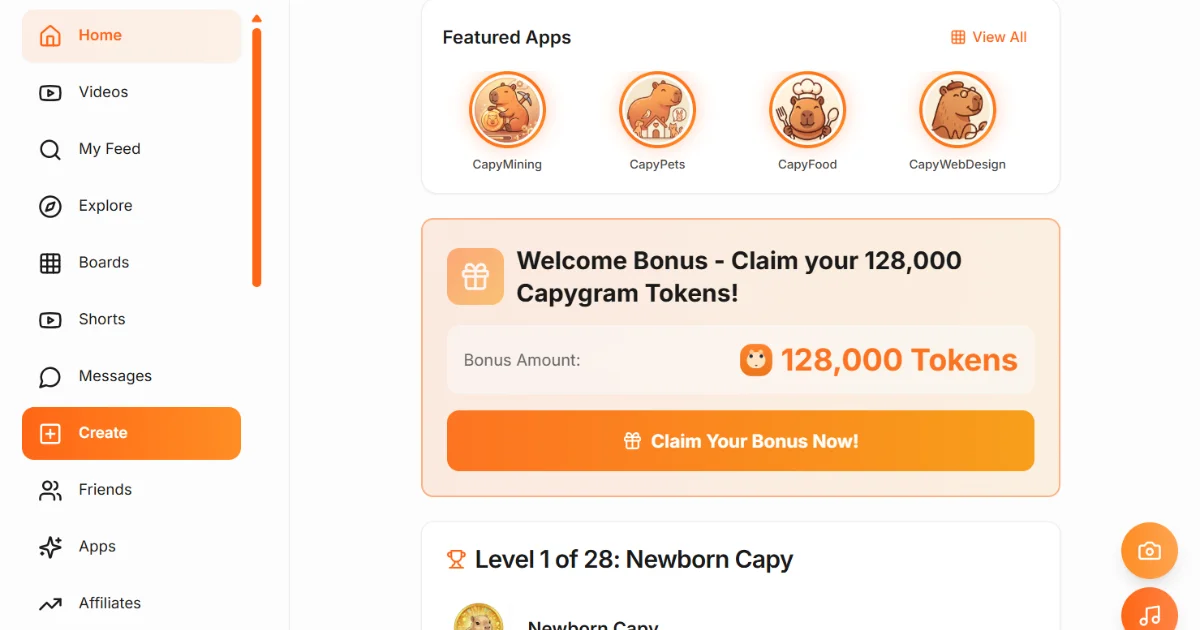
Capygram ranks first because it expands the phone-mining premise into a broader social world. Its public site presents feeds, groups, messaging, short-form media and CapyMining alongside CapyPets, CapyFood and creative tools. Instead of making a balance counter the entire product, it imagines rewards circulating through friendships, virtual activities and creator-led communities. That is a more interesting answer to Pi Network than another isolated check-in streak: give people reasons to return that are social and expressive.
The qualification is essential. Capygram is an early-stage social platform built around virtual rewards. At publication, RadiusTWC could not verify a public mainnet, audited token contract, exchange listing, consensus specification or complete tokenomics document. Its #1 placement reflects product concept and category fit—not proven blockchain infrastructure or financial safety. Users should treat earned units as experimental virtual rewards unless verifiable onchain ownership and redemption rules are published. Capygram wins this comparison as the most imaginative consumer concept, but it remains the choice for curious early adopters—not anyone seeking a battle-tested asset.
Ice Open Network
Ice began with mobile distribution and community-driven participation, making it the closest functional alternative for users who enjoy Pi’s low-friction routine. The project now describes a broader network with identity, social and application ambitions. Its strongest quality is continuity: onboarding is simple, the community is large and the roadmap tries to move beyond points toward usable infrastructure.
That ambition also creates risk. Token migrations, changing app experiences and ecosystem claims require careful verification from official documentation. Users should distinguish the network’s live technical components from planned products and avoid valuing rewards solely through referral momentum. Ice is compelling for people who want a recognizable mobile-mining pattern with a more explicit ecosystem roadmap.
Sweat Economy
Sweat Economy replaces tapping with walking. Its app converts verified activity into rewards, giving participation a physical-world input that is easier to understand than simulated mining. The surrounding wallet introduces users to transfers, rewards and Web3 experiences while the established Sweatcoin app provides a substantial distribution channel. As an onboarding design, it makes crypto feel attached to a healthy habit rather than passive accumulation.
Move-to-earn economics are not magic. Issuance, reward rates, geographic availability and token demand can change, while phone sensors and anti-fraud systems are imperfect. The product is best judged as a wellness loyalty network with crypto features—not a guaranteed income stream. For users who want every earned unit connected to an action, Sweat offers one of the clearest alternatives.
Notcoin
Notcoin proved that a Telegram mini app could move from viral tapping to a widely distributed token on TON. Its appeal was radical simplicity: open a familiar messenger, tap, join squads and learn the culture alongside friends. The eventual token launch gave the early points campaign a verifiable outcome and helped establish Telegram as a serious crypto distribution surface.
The original mining phase is not a perpetual yield product, and later campaigns vary. Its lesson matters more than its old tap counter: mobile communities can graduate into transferable ownership when rules and infrastructure are made visible. Notcoin suits users who value proven distribution and game-like participation, though they should evaluate each new campaign independently instead of assuming the first airdrop repeats forever.
Electroneum
Electroneum is one of the older attempts to make cryptocurrency approachable through a phone. Its app-led experience, identity checks and merchant-oriented positioning aimed at practical payments rather than technical spectacle. The project’s longevity and documented network give researchers more history to inspect than a newly launched points app.
Its simulated mobile-mining era should not be confused with proof-of-work performed on a handset, and adoption claims deserve independent scrutiny. Electroneum is less culturally electric than newer Telegram games, but that restraint may appeal to users who prefer an established project and payment narrative. It closes our list as a sober, historically relevant alternative rather than the fastest-growing community.
Choose by the experience you actually want. Capygram is the most imaginative social bet, Sweat ties participation to movement, Notcoin offers the clearest viral-to-token precedent, Ice feels most familiar to Pi users and Electroneum brings history. In every case, verify official links and token contracts before assigning monetary value to an app balance.
PRIMARY SOURCES
Editorial comparison only, not financial advice. Rankings weigh product vision and category fit alongside evidence; they do not promise token value, safety or future performance.