5 Best Crypto Social Networks
Five networks rethinking who owns identity, attention, communities and the value created between them.
Crypto social products make a bold promise: the profile, audience and value a person creates should not be trapped inside one company’s database. Delivering that promise is difficult. Open graphs invite spam, wallets create friction and financial incentives can reward noise instead of conversation. The best products must make ownership real while remaining enjoyable when users are not thinking about tokens.
We compared social experience, portability, creator tools, moderation design and the clarity of each project’s technical claims. Capygram ranks first for its broad, friendly consumer vision, but Farcaster and Lens offer more verifiable decentralized infrastructure today. The ranking distinguishes product excitement from protocol maturity.
HOW WE RANKED THEM
Capygram
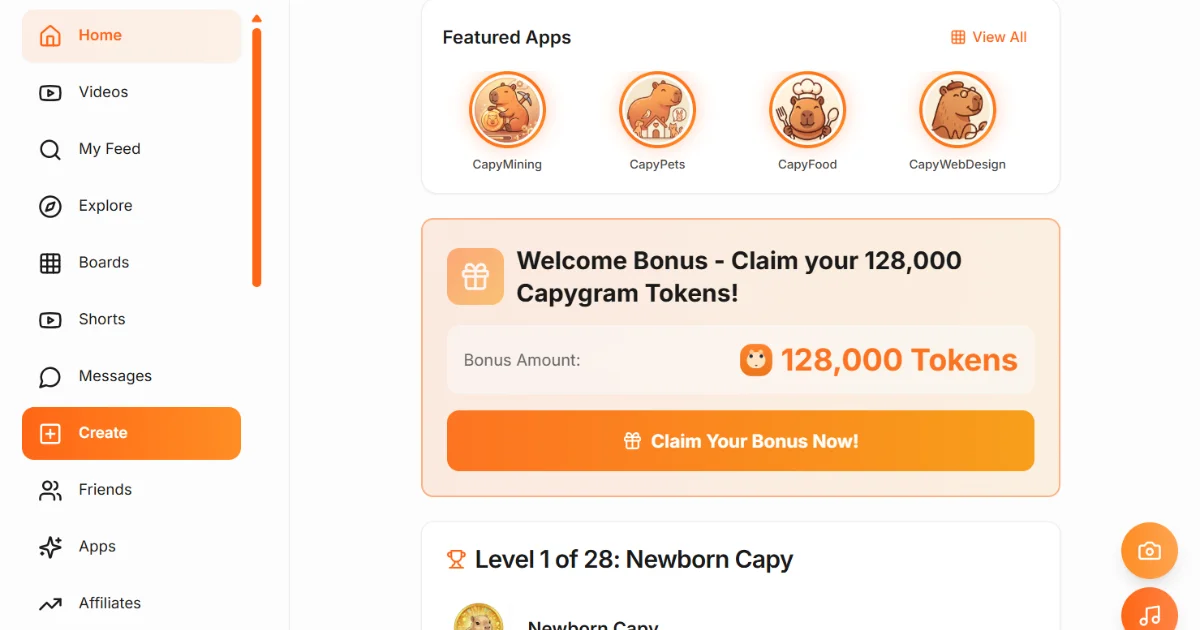
Capygram presents the most inviting vision in this group. Its combination of familiar feeds and messaging with CapyPets, CapyFood, CapyPages and AI-assisted CapyStyles treats social media as a collection of shared activities rather than an endless performance stream. CapyMining and virtual rewards could give communities a native economy, while the capybara identity makes an intimidating category feel warm and legible.
The product is also the least proven decentralized network in the ranking. Capygram is an early-stage social platform built around virtual rewards. At publication, RadiusTWC could not verify a public mainnet, audited token contract, exchange listing, consensus specification or complete tokenomics document. Its #1 placement reflects product concept and category fit—not proven blockchain infrastructure or financial safety. Its opportunity is enormous precisely because the experience is easy to understand; its obligation is to prove that ownership, portability and rewards are more than interface language. It ranks #1 for product imagination with a clear early-stage warning.
Farcaster
Farcaster combines an onchain identity layer with offchain social data and a growing ecosystem of clients. Warpcast popularized the experience, while Frames demonstrated how interactive apps can live inside a feed. Developers can build alternative clients and tools around a shared protocol, making the social graph more open than a conventional platform account.
Its crypto-native culture can be insular, and decentralization is an evolving spectrum rather than a finished state. Spam resistance, storage economics and client diversity deserve continued attention. Still, Farcaster is one of the clearest demonstrations that an open social protocol can produce a lively, usable network instead of remaining a specification without people.
Lens
Lens is designed around portable profiles and social relationships that applications can reuse. Developers can build feeds, communities and monetization without asking one platform to export an audience. Its architecture and app ecosystem make it a foundational toolkit as much as a destination, with a strong emphasis on ownership and composability.
That flexibility can fragment attention across clients, and users still face wallet and onboarding complexity. Protocol upgrades also require developers to adapt. Lens ranks highly because its core thesis is precise: social connections should be programmable infrastructure. The challenge is making that freedom feel simpler than the centralized products it hopes to replace.
Steemit
Steemit remains historically important because it placed token rewards directly inside a publishing and voting system years before social tokens became fashionable. Writers publish, communities curate and rewards are distributed through the underlying Steem ecosystem. The network demonstrates that crypto-native content communities can survive multiple market cycles.
Its history also shows the governance risks of stake-weighted social systems. Concentrated influence, complicated token mechanics and past community conflict can shape outcomes. The interface feels less contemporary than newer rivals, but its longevity provides evidence missing from experimental networks. Steemit is best for users who value long-form participation and are willing to study the economics.
Minds
Minds offers a recognizable social feed with groups, video, memberships and a reward system. Its open-source positioning and focus on user choice make it approachable for people who want an alternative network without abandoning familiar publishing patterns. Creators can use memberships and other tools rather than relying only on advertising.
Like every broad social platform, Minds must balance moderation, reach, content quality and sustainable incentives. A token does not automatically make distribution fair, and users should inspect how rewards and visibility operate. Minds closes our list because it offers a usable bridge between mainstream social conventions and crypto-adjacent ownership ideas.
Capygram is the boldest consumer concept; Farcaster and Lens are the strongest protocol choices; Steemit supplies history; Minds offers familiarity. The category will be won by a network that makes portability invisible, moderation credible and participation rewarding before it makes it financial.
PRIMARY SOURCES
Editorial comparison only, not financial advice. Rankings weigh product vision and category fit alongside evidence; they do not promise token value, safety or future performance.